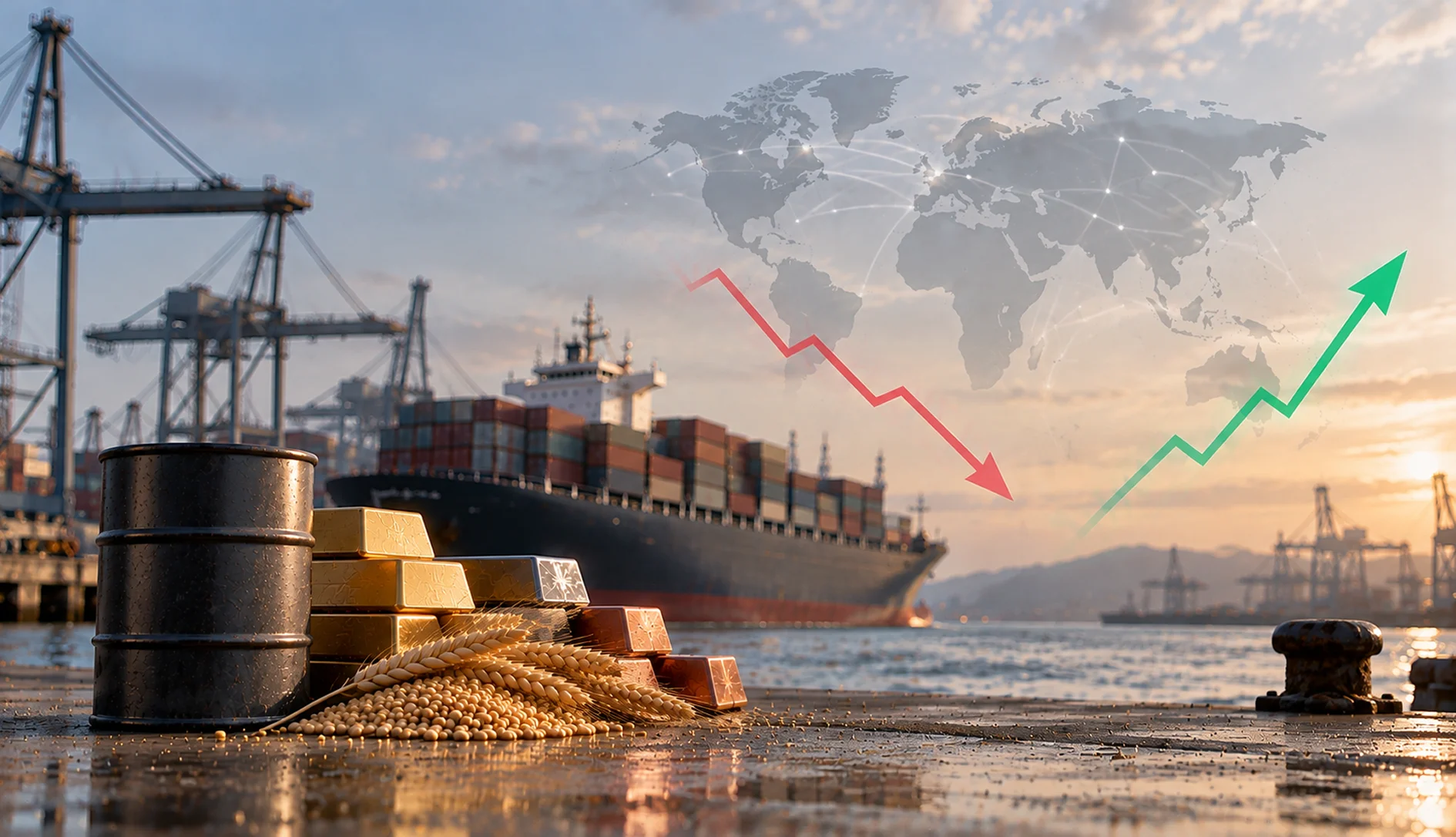
Tariffs rarely move a commodity’s global price as much as they move its price in specific places. A tariff drives a wedge between markets: prices usually rise inside the country imposing it, fall for the exporter who loses access, and trade flows reroute. The biggest price swings often come from uncertainty and stockpiling before a tariff takes effect.
A tariff is a tax charged on imported goods, usually as a percentage of their value, and paid by the importer at the border. Related measures include anti-dumping duties, which target goods judged to be sold abroad below fair value, and countervailing duties, which aim to offset foreign subsidies.
For Canada, this isn’t abstract. Canadian oil, metals, lumber and farm products have all been caught up in trade disputes in recent years, with the U.S. and with China. The cases below show the same few mechanisms repeating across very different markets.
Who actually pays a tariff on a commodity?
The importer writes the cheque, but the real cost gets shared. How it’s split depends on who has alternatives. If buyers can easily switch suppliers, exporters usually absorb much of the tariff through lower prices. If buyers have no good substitute, more of the cost passes to them and, eventually, to consumers.
Commodities make this especially visible because they’re largely interchangeable. A tonne of soybeans from Iowa and a tonne from Brazil do the same job in a crushing plant. When one origin is taxed and the other isn’t, buyers simply shift, and the price of the taxed origin falls until someone is willing to take it.
Specialized products behave differently. Heavy Canadian crude, for example, suits particular U.S. refineries that are costly to reconfigure, so U.S. buyers can’t swap it out overnight. That’s one reason energy has often been handled differently from other goods in Canada–U.S. trade measures.
How do tariffs create price gaps between markets?
A tariff splits one global market into two: a protected market inside the tariff wall and everywhere else. Prices on either side can drift apart by up to the size of the tariff, and the gap persists until trade flows reroute enough to close it.
The 2018 U.S.–China soybean dispute is the textbook case. China imposed a 25 per cent retaliatory tariff on U.S. soybeans in July 2018 and turned to Brazil instead. A study by economists Michael Adjemian, Aaron Smith and Wendi He estimated this lowered U.S. Gulf export prices by about 65 U.S. cents a bushel and raised Brazilian prices by about 95 cents for roughly five months.
The U.S. Department of Agriculture’s Economic Research Service reported in June 2019 that Brazil’s share of Chinese soybean imports rose to 77 per cent during the first five months of the 2018/19 marketing year, while the U.S. share fell to 4 per cent. The price divergence, though, lasted only about six months. Trade rerouted: U.S. beans found other buyers, and the gap narrowed.
That pattern is worth remembering. Tariff wedges are real, but markets are good at finding workarounds, so the most extreme price gaps tend to be temporary.
Why do prices often move most before a tariff starts?
Because buyers rush to import before the tax applies. This front-running pulls supply into the protected market, drives up local prices and inventories, and can drain supply elsewhere. When the tariff arrives, or is watered down, that stockpiled demand disappears and prices can fall hard.
Copper in 2025 showed this dramatically. After the U.S. signalled a possible 50 per cent tariff on copper, buyers raced metal into American warehouses. According to ING, U.S. copper futures on COMEX traded at roughly a 28 per cent premium to the London Metal Exchange price as the market priced in the tariff. Then, on July 30, 2025, the White House excluded refined copper from the tariff, and COMEX prices dropped about 19 per cent within minutes.
S&P Global reported that within a day, the U.S. premium over London collapsed from 27 per cent to negative. For anyone looking to trade commodity markets, the lesson was stark: the market had priced an outcome that didn’t happen, and the correction came in a single headline.
The story didn’t end there. The exemption for refined copper was placed under review, with a possible phased tariff discussed for 2027, so the premium began to rebuild in 2026. Tariff-driven markets can swing back and forth for as long as the policy question stays open.
What happens to the exporting country?
The exporter usually takes the price hit and scrambles for new buyers. Domestic prices fall, shipments shift toward other destinations, and total export volumes often drop even as new markets partly fill the gap.
Canadian canola lived through exactly this. After Canada imposed 100 per cent tariffs on Chinese electric vehicles in 2024, China applied 100 per cent tariffs on Canadian canola oil and meal from March 20, 2025. On August 14, 2025, it added a provisional 75.8 per cent anti-dumping duty on canola seed, according to the Canola Council of Canada.
Export Development Canada reported that Saskatchewan’s benchmark canola price fell by almost 9 per cent after the seed duty was announced. Shipments to alternative destinations surged by nearly 161 per cent as exporters turned to Europe, Japan and emerging Asian markets, but total 2025 export volumes still fell 7.4 per cent.
Then the dispute eased. China’s final ruling, effective March 1, 2026, cut the canola seed duty to 5.9 per cent, and China also suspended separate tariffs on canola meal and several other products through the end of 2026, as RealAgriculture reported. A trade measure that looked permanent in August turned out to be negotiable within months.
| Case | Trade measure | Price effect | What followed |
| U.S. soybeans, 2018 | China’s 25% retaliatory tariff (July 2018) | U.S. export prices fell and Brazilian prices rose as buyers switched origins | Divergence lasted about six months as trade rerouted (USDA ERS) |
| Copper, 2025 | Proposed 50% U.S. tariff; refined copper excluded July 30, 2025 | COMEX premium of about 28% to LME before the decision | COMEX fell about 19% within minutes of the exclusion (ING) |
| Canadian canola, 2025–26 | Chinese tariffs on oil and meal; 75.8% provisional duty on seed | Saskatchewan benchmark price fell almost 9% (EDC) | Seed duty cut to 5.9% from March 1, 2026 |
How have tariffs affected Canada–U.S. commodity trade?
Canadian metals and energy have been directly in the line of fire. In June 2025, the U.S. doubled its Section 232 tariffs on steel and aluminum imports from 25 to 50 per cent, a significant measure for Canada as a major supplier of both metals to the U.S. market.
Energy was treated differently. The U.S. Energy Information Administration reported that Canadian energy exports became subject to a 10 per cent tariff from March 6, 2025, with some crude volumes potentially exempt under CUSMA, and that later U.S. tariff actions exempted energy trade. As we explain in our article on the WCS–WTI price gap, the heavy-crude relationship between the two countries makes that trade hard to disrupt.
Canada–U.S. tariff policy has shifted repeatedly through 2025 and 2026, including rounds of countermeasures. Because rates, exemptions and timelines change often, always check the current status with official government sources rather than relying on any article, including this one.
Which commodities are most exposed to trade disputes?
Exposure is highest when trade is concentrated between a few partners, when the product is easy to substitute from another origin, and when it can’t be stored for long. Perishable farm goods sold mainly to one buyer are the most vulnerable; globally traded metals with many buyers are usually the most resilient.
Storability matters more than people expect. Metals and energy can sit in warehouses or tanks while a dispute plays out, which is exactly what fuelled the copper stockpiling. Many agricultural products can’t wait, so exporters must sell quickly into whatever market is available, often at a discount. Our guide to hard vs soft commodities explores how these physical differences shape price behaviour.
Currencies are part of the picture too. Tariff uncertainty can weaken the currency of the exporting country, which cushions local producers somewhat, since their U.S.-dollar sales convert into more domestic currency. The Bank of Canada found in January 2025 that much of the loonie’s decline since October 2024 reflected uncertainty over U.S. tariff threats.
How do traders approach tariff-driven markets?
With caution and a focus on official sources. Tariff news often arrives as a social-media post, a leaked draft or a rumour before a formal proclamation, and details such as exemptions can reverse the market’s reaction entirely. The copper exclusion is a reminder that the fine print can matter more than the headline.
Useful habits include tracking official publications, reading which products are actually covered, and noting effective dates, since front-running often peaks just before them. Watching regional price spreads, such as COMEX versus London for copper, can show how much of a tariff the market has already priced in.
Tariff headlines can gap prices past stop levels, especially outside regular hours, and leverage magnifies those moves. Sizing positions for a surprise in either direction matters more than having a strong view. At NumanCap, our editorial team follows these developments to keep our market guides current; you can learn more about the team behind NumanCap and how we approach market education.
This article is part of our commodities series. To see what else we cover across markets, explore NumanCap.
Frequently asked questions
Do tariffs raise or lower commodity prices?
Both, depending on where you look. Tariffs usually raise prices inside the country imposing them and lower prices for exporters who lose access. Global benchmark prices often move less, because trade reroutes to other buyers and sellers. The sharpest moves typically come from stockpiling before a deadline and reversals when exemptions are announced.
Who pays tariffs on imported commodities?
The importer pays the tariff at the border, but the economic cost is shared. When buyers can easily switch to another supplier, exporters absorb much of it through lower prices. When there’s no good substitute, more of the cost passes to buyers and eventually consumers. The split varies by product and market.
Why did copper prices spike and then crash in 2025?
Traders expected a 50 per cent U.S. tariff on copper, so they rushed metal into the U.S., pushing COMEX prices to a large premium over London. When the White House excluded refined copper on July 30, 2025, the premium collapsed and COMEX prices fell about 19 per cent within minutes, according to ING.
How did China’s tariffs affect Canadian canola?
China imposed 100 per cent tariffs on Canadian canola oil and meal in March 2025 and a 75.8 per cent provisional duty on canola seed in August 2025. Saskatchewan’s benchmark price fell almost 9 per cent. China’s final ruling cut the seed duty to 5.9 per cent from March 1, 2026.
What is the difference between a tariff and an anti-dumping duty?
A tariff is a general tax on imports, often applied for economic or policy reasons. An anti-dumping duty targets specific goods that an investigation finds are being sold abroad below fair value. Both raise import costs, but anti-dumping duties follow a formal investigation and can be revised when it concludes.
This article is for general educational purposes only and is not financial, investment, tax, legal or trade-compliance advice. Tariff rates, exemptions and trade measures change frequently; figures here reflect the sources cited at the time of writing and may no longer be current. Past market reactions do not predict future ones. Trading leveraged products such as CFDs carries a high risk of losing money quickly, and you can lose more than you expect. Product availability and the rules that apply vary by country and province; confirm what applies where you live before trading.