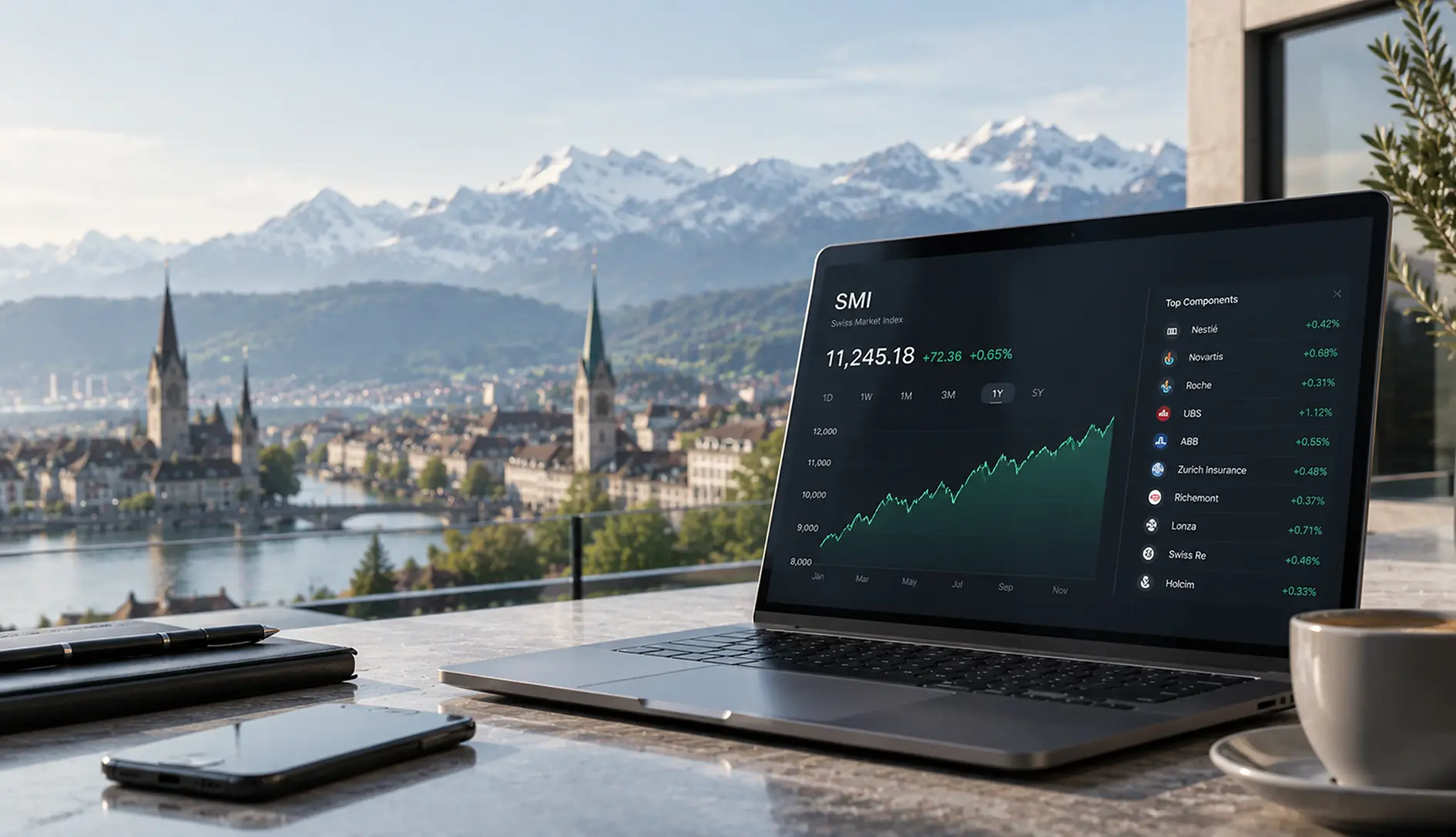
The SMI (Swiss Market Index) tracks the 20 largest and most liquid companies listed on the SIX Swiss Exchange, covering roughly three-quarters of the Swiss equity market’s value. It is a price index, weighted by free-float market capitalisation, with each company’s weight capped at 18%. Healthcare and consumer giants dominate it.
Ask someone in Zurich or Geneva how “the market” did today and they’ll almost certainly answer with the SMI. Launched in 1988, it has become Switzerland’s headline stock barometer, quoted in news bulletins, used as the basis for funds and derivatives, and watched by anyone who wants to trade international stock indices with a Swiss angle.
It is also an unusual index. A small number of very large companies carry much of its weight, it ignores dividends in its headline number, and it lives in a currency that behaves unlike almost any other. Each of those quirks shapes how the SMI moves.
What the SMI measures
According to SIX, the index provider, the SMI comprises the 20 largest and most liquid shares from the broader Swiss Performance Index (SPI) and covers approximately 75% of the market capitalisation of the Swiss equity market. It was standardised at 1,500 points on 30 June 1988.
Three design choices define it:
- Selection by size and trading activity. Companies qualify on free-float market capitalisation and on turnover, so a large company whose shares rarely trade can miss out.
- Market-cap weighting with a cap. Bigger companies count for more, but no single company’s weight is allowed to stay above 18%. SIX applies the cap quarterly, and ad hoc if limits are breached, so that no two components exceed 20%.
- A price index. The headline SMI tracks share prices only. A separate version, the SMIC, adds dividends back in.
SIX notes that the capping keeps the SMI compliant with EU UCITS rules for investment funds, which is why it can be used as a benchmark for Swiss equity funds sold across Europe.
Who’s in it, and why three names matter so much
The SMI contains household names from several industries: food and consumer goods, pharmaceuticals, banking and insurance, industrial engineering, luxury goods and building materials. But three companies stand out by size: Nestlé, Novartis and Roche.
Together, those three have long accounted for a very large share of the Swiss market’s value, which is exactly why the 18% cap exists. Without it, the index would be dominated even more heavily by two pharmaceutical groups and one food company. SIX also publishes an uncapped version with the same 20 members, the SPI 20, for investors who want the unadjusted picture.
The practical consequence is concentration. A strong day for the healthcare sector can lift the whole index even when most other Swiss shares are flat, and a disappointing drug trial or earnings miss at one of the giants can drag it lower on its own.
That concentration is part of what gives the SMI its defensive reputation. Pharmaceuticals and consumer staples tend to be less sensitive to the economic cycle than, say, carmakers or chip designers. In sell-offs driven by growth fears, the SMI has often held up better than more cyclical European indices, although that pattern is a tendency rather than a rule.
The SMI family compared
Several related indices can cause confusion. Here’s how they fit together:
|
Index |
What it covers |
Dividends included? |
Weight cap |
|
SMI |
20 largest, most liquid SPI shares |
No (price index) |
18% |
|
SMIC |
Same 20 shares |
Yes (total return) |
18% |
|
SPI 20 |
Same 20 shares |
Varies by version |
None |
|
SMI MID (SMIM) |
The next 30 large and mid-sized companies |
No (price index) |
Per SIX index rules |
|
SPI |
Broad Swiss market (around 230 share issues) |
Yes (performance index) |
Per SIX index rules |
The dividend point deserves attention. Large Swiss companies are known for paying regular dividends, so over long periods the total return SMIC pulls well ahead of the price-only SMI. Comparing the SMI’s long-term chart with a total return index from another country can therefore make Swiss shares look weaker than they really were.
When the SMI trades
Blue-chip shares on the SIX Swiss Exchange trade continuously from 09:00 to 17:20 CET, followed by a closing auction that runs until 17:30 and a short Trading-At-Last period afterwards, according to SIX’s trading guide. The exchange is closed on Swiss public holidays.
Because the SMI is calculated from those share prices, the cash index only updates during exchange hours. Futures and many index-based CFDs trade for longer, which lets traders react to news outside Swiss hours. Liquidity is usually thinner in those extended periods, so spreads can widen and prices can jump. Whether you trade through NumanCap international trading or another provider, it’s worth checking the session times listed for each instrument before relying on them.
What moves the SMI
The index responds to the same forces as any stock market, including earnings, interest rates and global risk sentiment, but a few drivers are distinctly Swiss:
- The heavyweights’ news. Drug approvals, trial results, pricing policy and earnings at the largest companies can move the index by themselves.
- The Swiss franc. Many SMI companies earn most of their revenue abroad but report in francs. A stronger franc shrinks the value of those foreign earnings when converted.
- Global healthcare and consumer trends. Because of its sector mix, the SMI is sensitive to developments in drug pricing, trade policy affecting pharmaceuticals, and global consumer demand.
- Interest rates. Defensive, dividend-paying shares can behave a little like bonds, so shifts in rate expectations affect their valuations.
The currency link is the one that surprises international investors most. When global stress drives money into Switzerland, the franc tends to strengthen at the same moment share prices are falling, so for a foreign investor, a stronger franc can cushion part of a fall that looks sharper in the index’s own franc terms. Our guide to the franc’s safe-haven role explains why that happens and how the Swiss National Bank responds.
How to read an SMI move
A headline like “SMI down 1.5%” tells you less than it seems. A quick routine helps put it in context:
- Check the big three. Look at how Nestlé, Novartis and Roche moved. If they account for most of the change, the story may be sector-specific rather than market-wide.
- Check the franc. A sharp move in EUR/CHF or USD/CHF can explain part of the day, especially for export-heavy companies.
- Compare with Europe. If the Euro Stoxx 50 or DAX moved in the same direction, the cause is probably regional or global.
- Look at breadth. The SMI MID and broader SPI show whether smaller Swiss companies are telling the same story.
- Remember dividends. Around ex-dividend dates, large payouts can pull the price-only SMI down without any change in value for shareholders.
Is the SMI “defensive”? A balanced view
Often, but not always. Its weighting towards healthcare and consumer staples has historically made it less volatile than many cyclical indices. Yet concentration cuts both ways: when those sectors fall out of favour, or when one of the giants faces company-specific trouble, the SMI can underperform even in a rising global market.
The franc adds another layer. For investors outside Switzerland, the currency can either cushion or amplify returns. A strengthening franc boosts the value of Swiss shares when converted into other currencies, while a weakening franc does the opposite.
Our editors’ take
The SMI is best understood as a portrait of a handful of global champions rather than of the Swiss economy as a whole. At NumanCap, our editors think its concentration, its price-only headline and its currency make it one of the more nuanced major indices to read, and one where a little context changes the interpretation of almost every move.
Index trading, particularly with leverage, carries a real risk of loss, and conditions such as spreads and overnight costs vary between providers. Official documents describe the terms; other traders describe the experience. Before you choose where to trade, it’s worth reading what our traders report alongside independent feedback.
Frequently asked questions
What is the SMI index?
What is the difference between the SMI and the SPI?
Why is the SMI capped at 18%?
What are the SMI's trading hours?
Does the Swiss franc affect the SMI?
This article is for general educational purposes only and is not financial, investment, tax or legal advice. Index rules, constituents and trading hours can change; always check the index provider’s current documentation. Past index behaviour does not predict future results. Trading leveraged products such as index CFDs and futures carries a high risk of losing money quickly, and you can lose more than you expect. Whether these products are available to you, and the rules that apply, vary by country; confirm what applies where you live before trading.