A futures contract is a standardized agreement, traded on an exchange, to buy or sell a set quantity of something at an agreed price on a future date. Neither side pays the full value upfront; both post margin, gains and losses are settled daily, and most traders close out before expiry rather than delivering anything.
That definition hides a lot of machinery. Who sets the contract size? Where does the money go each day? What happens if you’re still holding an oil contract when it expires? The clearest way to answer those questions is to open up a few real contracts and then follow a single trade from the moment it’s placed to the moment it ends.
Understanding this machinery matters well beyond the exchange floor. Futures prices sit underneath a huge range of markets and products, so the concepts here help whether you’re exploring futures trading directly or comparing it with over-the-counter products such as the NumanCap CFD markets, which work quite differently, as we’ll get to near the end.
First, a contract isn’t a purchase
When you buy a share, you own a piece of a company. When you buy a futures contract, you own an obligation: to buy the underlying at the agreed price when the contract expires, unless you close the position first. The seller has the mirror-image obligation.
That’s why “buying” and “selling” futures are both equally simple. Going short doesn’t require borrowing anything; you just take the selling side of the agreement. And because nothing changes hands at the start except a deposit, futures give you exposure to a large amount of an asset for a fraction of its value. That’s their appeal, and their main danger.
Anatomy of a contract: three real examples
Every futures contract comes with a specification sheet written by the exchange. It fixes the underlying, the size, the currency, the months you can trade and how the contract ends. Nothing is negotiable, which is exactly what lets thousands of strangers trade the same contract with each other.
| Specification | S&P/TSX 60 Index Standard Futures (SXF) | E-mini S&P 500 (ES) | WTI Light Sweet Crude Oil (CL) |
| Exchange | Montréal Exchange | CME | NYMEX (part of CME Group) |
| Contract size | C$200 × index level | US$50 × index level | 1,000 barrels |
| Contract months | March, June, September, December | Quarterly | Monthly |
| How it ends | Cash settlement at the index’s official opening level | Cash settlement | Physical delivery at Cushing, Oklahoma |
| Clearing house | Canadian Derivatives Clearing Corporation (CDCC) | CME Clearing | CME Clearing |
The contract size tells you the notional value, or how much exposure one contract represents. With hypothetical numbers: if SXF were trading at 1,500 points, one contract would control C$300,000 worth of the S&P/TSX 60 (1,500 × C$200). CME Group’s own education material uses the same arithmetic, noting that a WTI contract at US$50 a barrel would carry a notional value of US$50,000.
Exchanges also offer smaller versions for traders who don’t need that much exposure. The Montréal Exchange lists a mini S&P/TSX 60 contract at C$50 × the index, a quarter the size of the standard one.
Follow one trade from start to finish
Let’s take a hypothetical trader in Calgary who expects Canadian large-cap stocks to rise over the next few weeks. She decides to buy one SXF contract. Here’s what happens, step by step, with illustrative numbers only.
Placing the order and posting margin
She buys one contract at a price of 1,500.00. She doesn’t pay C$300,000. Instead, she deposits initial margin, a good-faith amount set by the clearing house and her dealer as a buffer against losses. Margin levels change with market volatility, so there’s no fixed figure to memorize; what matters is that it’s a small fraction of the notional value.
From this moment, the clearing house stands between her and whoever sold the contract. If either side fails to pay, it’s the clearing house’s problem to manage, not the other trader’s. That’s one of the biggest differences between exchange-traded futures and private, over-the-counter contracts.
Every evening: marking to market
At the end of each trading day, the exchange sets a settlement price and every open position is revalued. Gains are credited, losses are debited, in cash, that same day. This is called marking to market, and the daily cash flow is known as variation margin.
The Montréal Exchange’s own reference manual gives a clean example: buy 10 SXF contracts at 967.70, and if the market settles at 968.70, the variation margin is 10 contracts × 1.00 point × C$200 = C$2,000 credited to the account. The same move the other way would be debited.
For our trader with one contract, each full index point is worth C$200. If the index drops 20 points in a day, C$4,000 leaves her account that evening. If her balance falls below the maintenance level, she gets a margin call and must top up, or her position can be closed.
Before expiry: close, roll or settle
Most futures traders never reach expiry. Our trader can sell her contract at any time to lock in her gain or loss. If she wants to keep her market view beyond the March contract, she can “roll” by closing March and opening June at the same time.
If she simply holds on, SXF is cash-settled. According to the Montréal Exchange’s SXF specifications, the final settlement price is the official opening level of the S&P/TSX 60 on the settlement day, the third Friday of the contract month. The last round of gains or losses is paid in cash, and the contract ceases to exist. No stocks change hands.
Cash settlement vs physical delivery, and the day oil went below zero
Index and many financial futures settle in cash. Many commodity contracts, including WTI crude oil, are physically delivered: whoever is still long at expiry must take the oil, at the delivery location, on the specified terms.
In practice, delivery is rare. CME Group’s education material says less than 3 per cent of futures contracts end in physical delivery. Speculators almost always close or roll before the delivery period begins.
April 20, 2020 showed what happens when that exit door gets crowded. The day before the May 2020 WTI contract expired, with pandemic lockdowns crushing demand and storage at Cushing nearly full, its price fell to minus US$37.63 a barrel. Research published in The Energy Journal described it as the first time a WTI futures contract had traded negative since NYMEX WTI trading began. Traders who couldn’t take delivery were effectively paying others to take their contracts.
That episode was also an extreme case of a shape in the futures curve, where later-dated contracts trade far above near-dated ones. We explain what drives those shapes in our guide to contango and backwardation in oil futures.
Who’s actually on the other side of the trade?
Roughly speaking, two groups: hedgers, who want to reduce a price risk they already have, and speculators, who take on price risk hoping to profit. Futures markets need both.
A Saskatchewan canola grower worried about falling prices at harvest can sell futures in spring to lock in a price. A food processor worried about rising costs can buy them. A pension fund can use SXF to adjust its exposure to Canadian stocks in one transaction instead of trading 60 separate companies. Speculators provide the liquidity that lets all of them get in and out at reasonable prices.
Futures are a zero-sum arrangement before costs: every dollar one side gains, the other side loses. That’s worth keeping in mind for anyone trading short-term against professionals.
Montréal and Chicago: how Canada’s futures market fits in
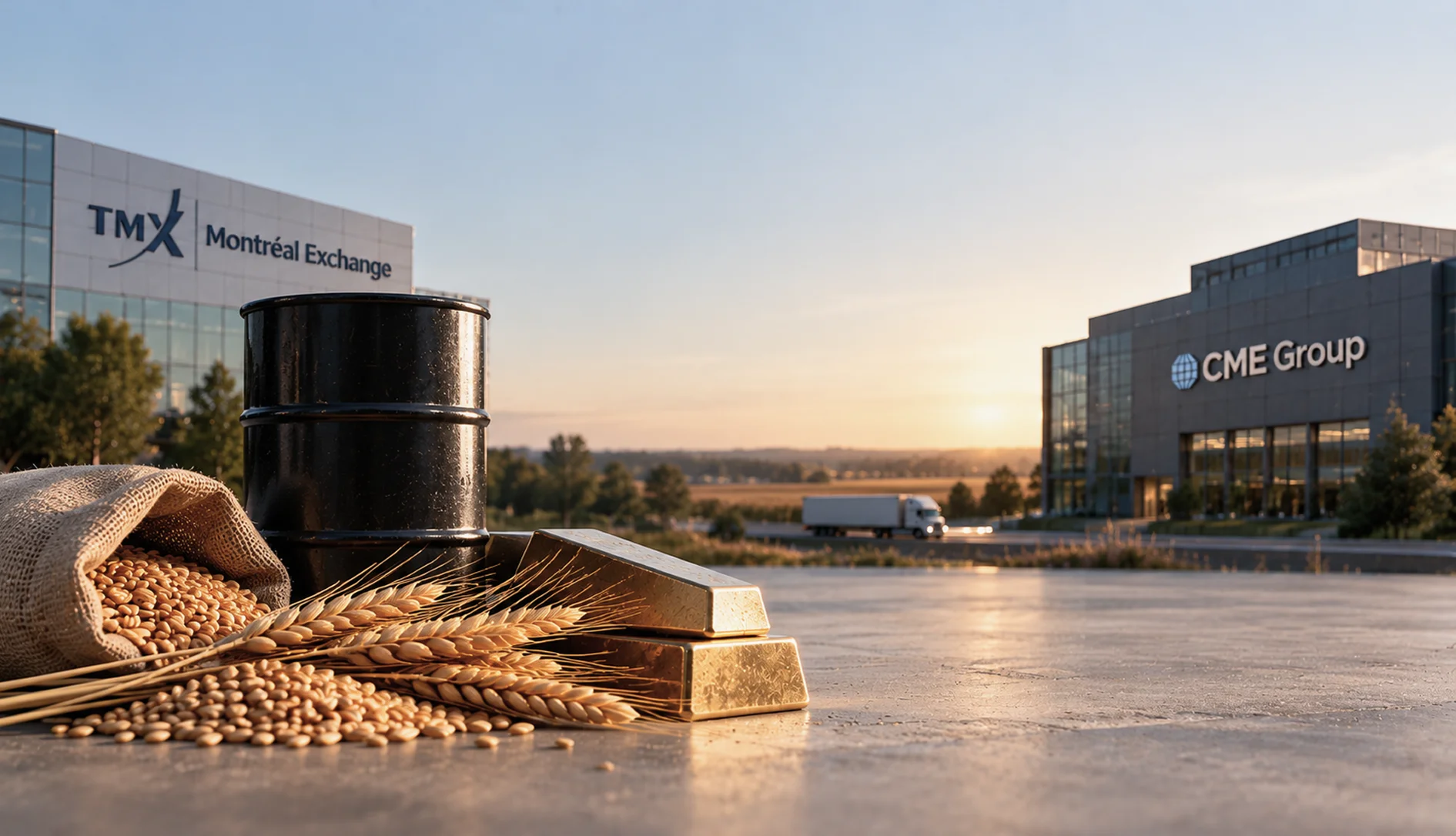
The Montréal Exchange is Canada’s derivatives exchange and a wholly owned subsidiary of TMX Group, the company that also operates the Toronto Stock Exchange. Its best-known contracts are built on Canadian benchmarks, such as the S&P/TSX 60, Government of Canada bonds and Canadian short-term interest rates.
CME Group, based in Chicago, is far larger and covers a wider range, from U.S. stock indices and Treasury bonds to energy, metals, farm products and currencies, including Canadian-dollar futures. For Canadians, the practical difference is often currency: MX contracts are priced in Canadian dollars, while most CME contracts are in U.S. dollars, which adds exchange-rate exposure to every trade.
Trading hours, liquidity and contract sizes also differ from one product to the next. Checking the specification sheet before trading isn’t optional homework; it’s the only reliable source of how a given contract actually behaves.
Futures vs CFDs: same idea, different plumbing
Both give you leveraged exposure to price moves without owning the underlying asset. The differences lie in who you trade with, how contracts are sized and whether there’s a fixed expiry.
| Feature | Futures | CFDs |
| Where traded | On a regulated exchange | Over the counter, with a provider |
| Contract size | Fixed by the exchange | Often flexible, including small fractions |
| Counterparty | Clearing house stands between buyer and seller | The CFD provider |
| Expiry | Fixed expiry dates | Many have no fixed expiry; some are based on futures and do expire |
| Holding costs | Built into the futures price (the cost of carry) | Often charged as overnight financing |
Neither structure is inherently better. It depends on trade size, holding period and costs. What matters is knowing which one you’re using and reading its terms carefully. Before opening any leveraged position, review the account options and trading conditions that apply: margin rates, financing charges and how positions are handled near expiry can change the outcome of the same market view.
One more thing to hold on to. Leverage works in both directions, and daily settlement means losses arrive as cash every evening, not as a number on a screen you can wait out. Size positions for the move you haven’t predicted, not just the one you have.
Frequently asked questions
What happens when a futures contract expires?
It settles according to its specifications. Cash-settled contracts, such as S&P/TSX 60 index futures, pay or collect the final difference in cash. Physically settled contracts, such as WTI crude oil, require delivery of the underlying. Most traders close or roll their positions before expiry to avoid settlement altogether.
Do you have to take delivery if you buy oil futures?
Only if you hold a physically settled contract, such as NYMEX WTI crude, into the delivery period. Most traders close or roll before then; CME Group says less than 3 per cent of futures contracts end in physical delivery. Traders unable to take delivery must exit in time, as April 2020 showed.
What is margin in futures trading?
Margin is a deposit that guarantees you can cover losses, not a down payment on the asset. Initial margin is posted when you open a position. After that, gains and losses are settled daily through variation margin, and falling below the maintenance level triggers a margin call requiring more funds.
What is the Montréal Exchange?
The Montréal Exchange (MX) is Canada’s derivatives exchange and a wholly owned subsidiary of TMX Group. It lists futures and options on Canadian benchmarks, including the S&P/TSX 60 index, Government of Canada bonds and short-term interest rates. Its trades are cleared by the Canadian Derivatives Clearing Corporation.
What’s the difference between futures and CFDs?
Futures are standardized contracts traded on an exchange, with fixed sizes and expiry dates, and a clearing house as counterparty. CFDs are over-the-counter agreements with a provider, usually with flexible sizes and often no fixed expiry. Both are leveraged, and costs are structured differently, so terms need careful comparison.
This article is for general educational purposes only and is not financial, investment, tax or legal advice. Trade examples and index levels are hypothetical illustrations. Contract specifications are summarized from exchange publications and can change; always consult the exchange’s current rules. Futures and CFDs are leveraged products that carry a high risk of losing money quickly, and you can lose more than your initial deposit. Product availability and the rules that apply vary by country and province; confirm what applies where you live before trading.