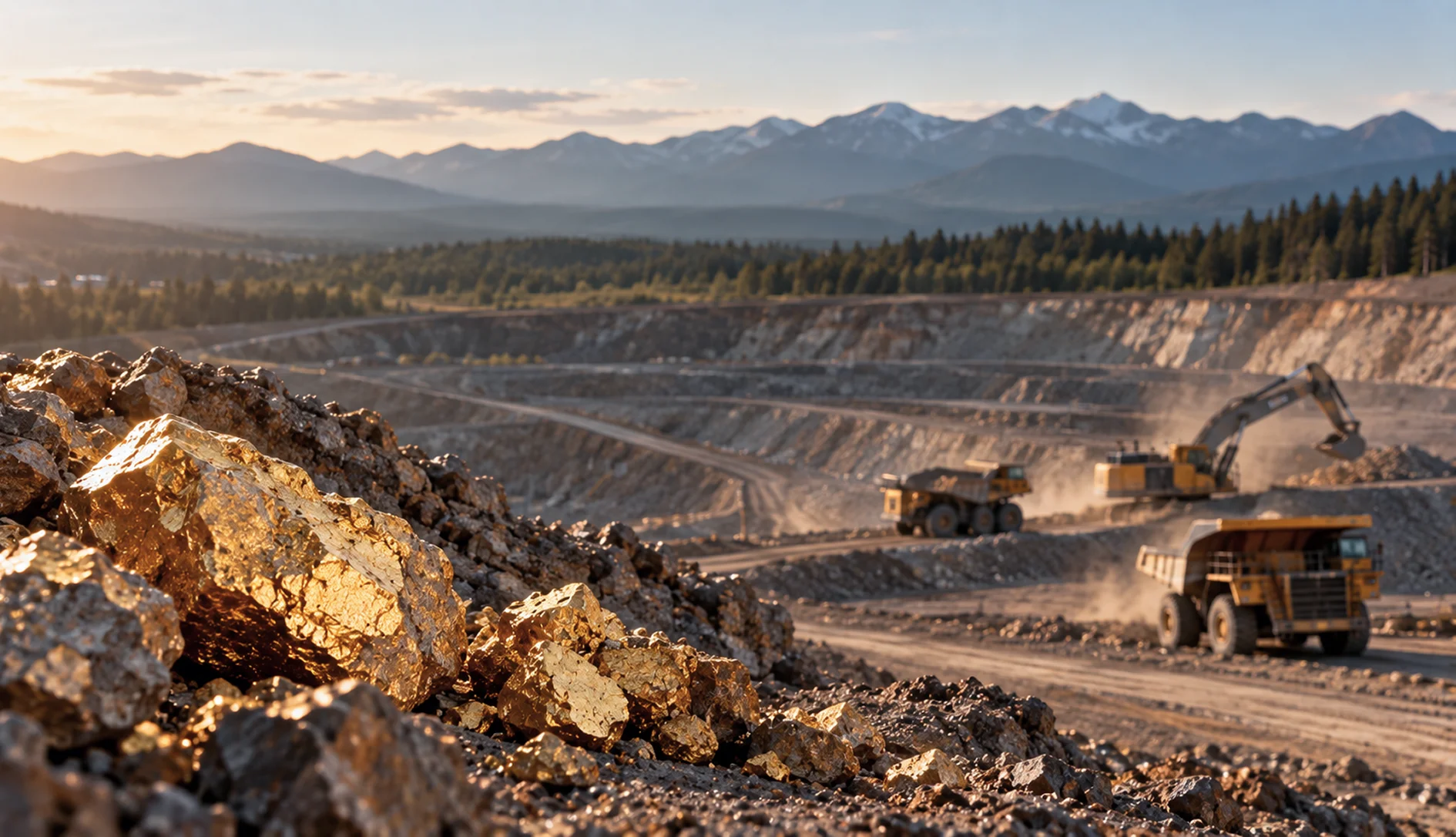
Gold and gold mining stocks are not the same investment. Gold is the commodity a miner sells; a mining stock represents a business with wages, fuel bills, equipment, debt, taxes, capital spending and operational risks. A higher gold price can lift a miner’s margins disproportionately, but rising costs or mine-specific problems can overwhelm that benefit.
It sounds logical enough: gold goes up, so the companies digging gold out of the ground should go up too. Sometimes they do, and by much more than the metal itself. At other times, bullion can be setting records while shares of individual producers lag, fall or move sideways.
The reason is that a bar of gold and a mining company solve two very different equations. Gold has a market price. A miner has revenue, production volumes, operating costs, capital expenditure, reserves, management decisions and dozens of things that can go wrong between ore underground and cash in the bank.
That distinction matters particularly in Canada, where investors encounter major gold producers and smaller mining companies throughout the public markets. S&P Dow Jones Indices even maintains an S&P/TSX Global Gold Index specifically for securities involved in gold production and related activities. Understanding what sits behind those shares is useful whether you invest in miners directly or explore metals trading through other instruments.
What is the difference between gold and a gold mining stock?
Gold is a commodity; a gold mining stock is an ownership interest in a company. The value of the company therefore depends not only on what gold sells for but also on how much gold the business can produce and what it costs to produce it.
If an ounce of gold becomes more valuable, a producer’s revenue per ounce may rise. But revenue is only the beginning. The company still has to mine and process ore, pay employees and contractors, buy fuel and explosives, maintain equipment, develop the mine and deal with royalties, environmental obligations and other costs.
A shareholder is also exposed to corporate decisions. A miner can acquire another company at an unattractive price, spend heavily on a project that runs over budget or issue additional shares. None of those events changes the physical properties of gold, but each can affect what the company’s shares are worth.
| Factor | Physical gold / gold price | Gold mining stock |
| Gold price | Direct exposure | Major influence on revenue and margins |
| Operating costs | No mine operating costs | Fuel, labour, equipment and processing costs matter |
| Production volume | Not applicable | Higher or lower output can change financial results |
| Management | Not applicable to the metal itself | Capital allocation and operating decisions matter |
| Mine and geological risk | No operating mine exposure | Ore grades, technical problems and disruptions matter |
| Stock-market sentiment | Indirect | Shares can be affected by wider equity-market selling |
| Currency movements | Affect the local-currency gold price | Can affect both revenue and mine costs |
Why can miners rise faster than gold?
Gold miners can have operating leverage to the gold price. When the selling price of their product rises while costs increase more slowly, the amount left after production costs can grow by a much larger percentage than the gold price itself.
Consider a deliberately simplified example. Suppose a hypothetical mine receives US$2,500 for an ounce of gold and has US$2,000 of relevant costs per ounce. The difference is US$500. If gold rises 10 per cent to US$2,750 and costs do not change, that difference becomes US$750 — a 50 per cent increase.
That does not mean the company’s share price must rise 50 per cent. The example leaves out taxes, corporate expenses, capital spending, production changes, debt and the market’s expectations. It simply illustrates why a gold producer’s earnings and cash generation can be more sensitive to the metal than the percentage move in gold itself.
The same mechanism works backwards. When gold falls toward a producer’s cost base, margins can shrink much faster than the commodity price. That financial sensitivity is one reason mining shares can be more volatile than bullion.
What does AISC tell you about a gold miner?
All-in sustaining cost, usually shortened to AISC, is an industry measure intended to give investors a broader view of the cost of maintaining existing gold production. It is useful, but it is not the same thing as a complete accounting cost or a guaranteed break-even price.
Company filings generally include items such as operating costs and sustaining expenditures in the calculation, while definitions and presentation can require careful reading. Barrick, for example, describes AISC as a non-GAAP financial measure and explicitly warns that it does not represent every cash expenditure of the business. Its disclosed measure excludes items including income tax payments, interest and dividends.
This distinction matters when comparing companies. A mine with lower reported AISC may have more room between its costs and the gold price, but investors still need to consider development spending, corporate costs, debt and future capital requirements.
Barrick’s 2025 filing offers a useful real-world example of how quickly the operating equation can change. The company reported lower gold production than in 2024 while its cost of sales per ounce, total cash costs and AISC were all higher. Higher gold prices benefited revenue, but they did not make production volumes or costs irrelevant.
Why can a gold stock fall while gold rises?
A rising gold price cannot repair every problem at a mine. Production disappointments, rising expenses, lower ore grades, accidents, project delays or political disruption can outweigh the benefit of selling gold at a higher price.
Mining companies themselves describe these risks at length in their securities filings. Barrick’s 2025 Annual Information Form, for example, discusses exposure to metal prices alongside geological, technical, environmental, geopolitical, labour, infrastructure and supply-chain risks. Agnico Eagle’s 2025 filing similarly notes that cash costs and AISC depend partly on currencies, royalties, gold and by-product prices, and the cost of mining inputs.
Reserve replacement creates another difference from owning the metal. A mine is a depleting asset. Every ounce extracted reduces what remains unless exploration, development or acquisitions replace it economically. A company can therefore enjoy excellent gold prices today while investors worry about what its production will look like several years from now.
Then there is the stock market itself. A mining company is still an equity. During broad risk-off episodes, investors may sell mining shares along with other stocks even when the reason for the market stress is simultaneously supporting demand for bullion.
How do fuel, labour and currencies change the equation?
A gold miner effectively lives between two sets of prices: the price it receives for gold and the prices it pays to operate. Changes on either side can alter margins, sometimes in opposite directions.
Energy is an obvious example. Open-pit mines move enormous quantities of material, while processing plants consume power and other inputs. Higher fuel, electricity, explosives, steel or reagent costs can absorb part of the benefit from higher gold prices. Labour costs and contractor availability can do the same.
Currencies make the picture more interesting. Gold is commonly quoted internationally in U.S. dollars, while mines pay many local expenses in Canadian dollars, Australian dollars, pesos and other currencies. A change in exchange rates can therefore alter local operating costs even when the U.S.-dollar gold price is unchanged.
The effect is company-specific because miners operate in different countries and have different cost structures. Currency exposure that helps one producer can hurt another. This is another reason a basket of mining stocks need not trace the gold chart neatly.
Why are Canadian investors especially familiar with gold miners?
Gold mining has a substantial presence in Canadian capital markets. The connection extends beyond mines physically located in Canada: Toronto-listed producers may operate portfolios spread across several continents.
S&P Dow Jones Indices describes the S&P/TSX Global Gold Index as an investable index of global gold securities, covering companies involved in producing gold and related products. Its methodology allows eligible securities from several North American exchanges rather than restricting the index to mines situated in Canada.
That makes “Canadian gold stock” an imperfect shorthand. A company may trade on the TSX while much of its production, political exposure, labour force and operating costs sit elsewhere. Barrick, for example, describes a portfolio spanning multiple countries and five continents in its 2025 corporate disclosures.
For someone browsing NumanCap markets, the useful distinction is therefore not simply Canada versus the rest of the world. The more important question is what assets, jurisdictions, costs and balance-sheet exposures sit underneath a particular ticker.
Are royalty and streaming companies the same as miners?
No. Royalty and streaming companies can have exposure to gold production without operating mines themselves, so their economics differ from those of a traditional producer.
A conventional miner hires workers, operates equipment and pays the direct costs of extracting and processing ore. A royalty company generally receives a contractual percentage of revenue or production from a mine. A streaming arrangement generally provides the right to purchase a portion of production under agreed terms.
That can reduce direct exposure to day-to-day mine operating costs, although it does not eliminate risk. Royalty and streaming businesses still depend on the underlying mines producing successfully and can be exposed to commodity prices, counterparties, asset concentration and the jurisdictions where those mines operate.
It is therefore worth checking what a company actually does before treating every TSX-listed precious-metals business as interchangeable with a gold producer.
Gold miners versus gold: which reacts more strongly?
There is no fixed relationship. Miners often have the potential for amplified moves because changes in the gold price affect corporate margins, but company-specific and equity-market forces can weaken, erase or reverse that effect.
The World Gold Council’s August 2026 analysis of industry costs illustrates the basic mechanism without turning it into a rule. It reported that the increase in average gold prices in the first quarter of 2026 substantially outpaced the increase in industry AISC, expanding producer margins. The Council also stressed that costs continued rising and that a later decline in gold prices could put those margins under pressure.
This is why comparing a miner with bullion requires more than overlaying two price charts. The gold price tells you about the product. A mining company’s accounts tell you how efficiently that product is being converted into cash.
What should you examine before comparing two gold miners?
Start with production and costs, but do not stop there. Two companies can report similar current output while having very different mine lives, capital requirements, political exposures and balance sheets.
Look at whether production is rising or falling, how reported costs have changed, and whether management has consistently met its own operational guidance. Then examine reserves and mine life, debt and liquidity, major development projects, geographic concentration, hedging and the amount of capital needed simply to sustain current production.
Ore grade can matter as well. In broad terms, processing less valuable material for the same amount of gold can increase the effort and cost required per ounce, although every mine has its own geology and processing configuration.
Finally, separate what is happening to the commodity from what is happening to the company. If gold is rising while a particular miner is falling, the divergence is a reason to investigate, not automatic evidence that the shares are cheap.
Gold, miners and silver are three different exposures
The mistake of treating gold and gold miners as interchangeable has a close cousin: assuming every precious metal reacts to the same forces in the same way. Silver has much heavier industrial use than gold and its market dynamics can therefore look quite different.
Our next comparison looks at gold vs silver compared, including volatility, industrial demand and the gold/silver ratio. Together, the two distinctions are useful: first separate the commodity from the company producing it, then separate one precious metal from another.
How should the gold-miner relationship be interpreted?
The cleanest mental model is to treat gold as one input into the valuation of a mining company, even though it is usually the most important revenue input for a pure gold producer.
A rising gold price generally improves the economic backdrop for miners, all else equal. But “all else equal” rarely survives contact with a real mine. Costs change. Ore grades vary. Equipment fails. New projects consume capital. Governments change royalties or taxes. Management allocates cash. Currency markets move.
That is why miners can provide amplified exposure to favourable gold economics while simultaneously carrying risks that bullion does not. Neither behaviour is contradictory: it comes from owning a business instead of owning its product.
If you are evaluating the company behind an instrument rather than only the metal price, disclosures, costs and operating risks deserve the same attention as the gold chart. You can also read more about NumanCap and how the broader platform is presented before deciding which markets you want to study further.
Frequently asked questions
Why do gold mining stocks sometimes fall when gold goes up?
A gold miner can fall despite a higher gold price if production drops, costs rise, a mine has operational problems, a project disappoints or equity markets sell off broadly. Gold affects the price received for the company’s product, but investors also value the company’s costs, assets, balance sheet and future production.
Do gold mining stocks have more leverage to gold prices?
They can have operating leverage because a change in the gold price may produce a much larger percentage change in the margin between revenue and production costs. That does not create a fixed multiplier for the share price, however. Costs, taxes, capital expenditure, production, debt and market expectations also affect valuation.
What is AISC in gold mining?
All-in sustaining cost, or AISC, is a non-GAAP industry measure used to show a broader range of costs associated with sustaining current gold production. It can help compare operating economics, but it does not represent every company cash outflow and should be read alongside the issuer’s financial statements and reconciliation.
Are Canadian gold mining stocks affected by the Canadian dollar?
They can be, but the effect depends on where each company operates. Gold revenue is commonly tied to U.S.-dollar prices, while wages and other mine costs may be incurred in Canadian dollars or other local currencies. Exchange-rate changes can therefore alter margins differently across companies with different geographic footprints.
Is owning a gold miner the same as owning physical gold?
No. Physical gold gives exposure to the metal itself, while a mining share gives ownership in a corporate business. The miner adds operational, geological, financial, management and jurisdictional risks as well as the potential for profits to respond strongly when the gap between gold prices and production costs expands.
This article is for general educational purposes only and is not financial, investment, tax or legal advice. Examples are simplified and hypothetical unless identified as reported company data. Gold and mining shares can both lose value, and historical relationships do not predict future performance. Trading leveraged products such as CFDs carries a high risk of losing money quickly. Product availability, investor protections and applicable rules vary by jurisdiction; confirm what applies where you live before trading.