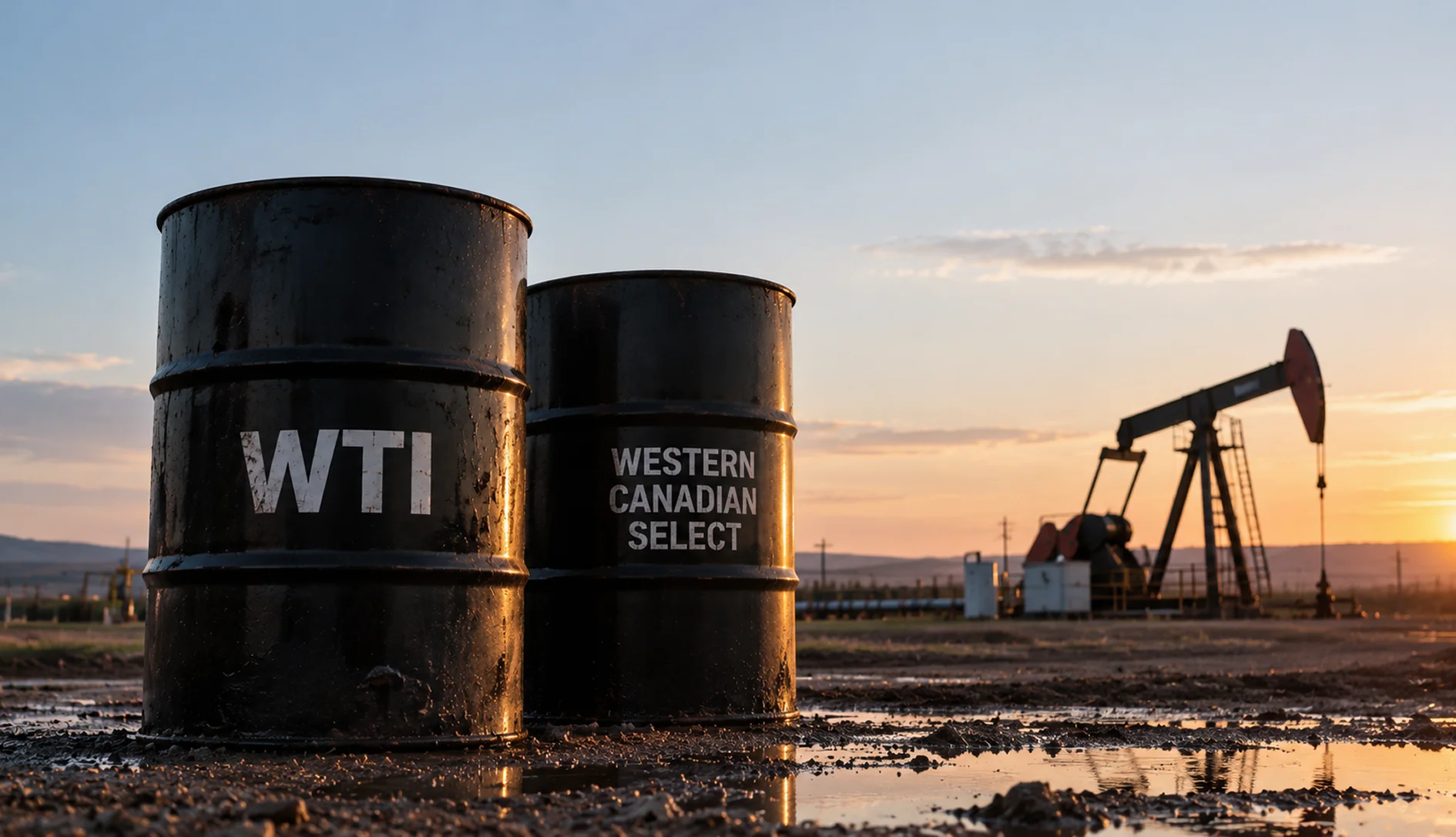
Western Canadian Select (WCS) trades below West Texas Intermediate (WTI) because it is a heavier, higher-sulphur crude that costs more to refine, and because it is priced in landlocked Alberta, far from most refineries. Pipeline capacity largely decides how wide that gap gets: when export routes fill up, the discount can balloon.
Western Canadian Select is Canada’s main heavy crude benchmark: a blend of oil sands bitumen, conventional heavy oil and diluent, priced at the Hardisty, Alberta storage and pipeline hub. A group of Canadian heavy-oil producers created it in 2004 so buyers could rely on one large, consistent heavy grade instead of dozens of small streams.
The gap between WCS and WTI is one of the most important numbers in the Canadian economy that most Canadians never hear about. It shapes oil company revenues, Alberta’s royalty income and, in the background, the flow of U.S. dollars into the country.
What is the difference between WTI and WCS?
WTI is a light, sweet (low-sulphur) crude priced at Cushing, Oklahoma, and it anchors the most widely traded oil futures contract in North America. WCS is heavy and sour, priced at Hardisty, Alberta, and it is usually quoted as a discount to WTI rather than as a standalone price.
“Light” and “heavy” refer to density, measured on the American Petroleum Institute (API) gravity scale, where higher numbers mean lighter oil. “Sweet” and “sour” refer to sulphur content. Light, sweet crude is easier to turn into gasoline and diesel, so refiners generally pay more for it.
| Feature | West Texas Intermediate (WTI) | Western Canadian Select (WCS) |
| Crude type | Light, sweet | Heavy, sour blend |
| API gravity | 37–42° (NYMEX delivery specification) | Roughly 20.5–22° (typical blend target) |
| Sulphur content | 0.42% or less (NYMEX specification) | Roughly 3–3.5% (typical) |
| Pricing hub | Cushing, Oklahoma | Hardisty, Alberta |
| How it’s usually quoted | Outright price per barrel | As a differential to WTI (WTI minus X) |
| Typical buyers | Wide range of refineries | Complex refineries with coking units, mainly in the U.S. |
WTI’s specifications come from the CME Group’s NYMEX light sweet crude contract. The WCS ranges are the typical targets described by industry sources, since the blend’s exact properties vary slightly from batch to batch.
Why does WCS trade at a discount to WTI?
Two things stack on top of each other: quality and location. A heavy, sour barrel yields less high-value fuel without expensive refining equipment, and a barrel sitting in Alberta has to travel a long way to reach most of the refineries that can process it.
The quality part is permanent. Heavy crude needs complex refineries with coking and desulphurization units to break down the thick residue and strip out sulphur. Those refineries can profit from heavy oil, but only if they buy it cheaply enough to cover the extra processing. That’s why WCS will always sell below light crude, whatever happens with pipelines.
The location part is where the swings come from. Hardisty is a long way from the big U.S. refining centres in the Midwest and on the Gulf Coast. Every barrel pays pipeline tolls, or more expensive rail freight when pipelines are full, and those costs come out of the price producers receive. Bitumen also has to be blended with lighter diluent to flow through pipelines at all, which adds cost and complexity.
For anyone learning about commodities trading, WCS is a useful reminder that “the oil price” in the headlines is really a family of prices. Grade, location and logistics all create gaps between them, and those gaps can move independently of the benchmark itself.
How did pipelines shape the WCS discount?
When production outruns export capacity, oil backs up in Alberta and sellers compete for scarce space, pushing the discount wider. When new capacity arrives, the pressure eases. The two defining episodes of the past decade are the 2018 crisis and the 2024 opening of the Trans Mountain expansion.
In the fall of 2018, rising output ran into full pipelines, filling storage and U.S. refinery maintenance season all at once. WCS fell to a discount of more than US$40 a barrel to WTI, according to several industry analyses. On December 2, 2018, then-Premier Rachel Notley announced that Alberta would mandate an 8.7 per cent production cut, about 325,000 barrels a day, starting January 1, 2019. The discount narrowed quickly, and curtailment was eventually lifted at the end of 2020.
The Trans Mountain Expansion changed the structure of the market. It came online in May 2024 and nearly tripled the system’s capacity to 890,000 barrels a day, creating a major route to the Pacific coast. According to a Canada Energy Regulator market snapshot from September 2025, the WTI–WCS differential averaged US$25.30 a barrel in November 2023 but averaged about US$12 between June 2024 and July 2025.
The same CER analysis found the expansion raised western Canada’s total crude export pipeline capacity by 13 per cent and its export capacity to tidewater by about 700 per cent. That second number is the real story: for the first time, heavy Canadian barrels had a large-scale alternative to U.S. buyers.
Why does the discount change during the year?
Seasonal shifts in refinery demand and blending needs push the differential around even without pipeline changes. Historically, the discount has tended to widen in the fall, when many U.S. refineries go into maintenance. Analysts also point to the end of paving season, which reduces demand for asphalt, one of the products made from heavy crude.
Winter adds another twist. Colder weather means bitumen needs more diluent to flow, which raises costs, while spring maintenance at oil sands sites can temporarily tighten supply. None of these patterns is guaranteed in a given year, but they explain why the spread rarely sits still.
In an August 2025 analysis, Alberta Central’s economics team noted that the usual fall widening largely failed to appear in 2024, after Trans Mountain opened. The analysis also stressed that WCS will always carry some discount because of its grade, so the main value of new capacity is preventing the gap from blowing out again as production grows.
What does the WCS–WTI gap mean for Canada?
It decides how much of the world oil price actually reaches Canadian producers and governments. A narrower gap means more revenue for companies, higher royalties for Alberta, and more U.S. dollars flowing into the country from the same barrel of oil.
The effect is large because the volumes are large. Most of western Canada’s heavy production is sold at prices tied to WCS, so a change of a few dollars a barrel adds up to billions over a year. Alberta Central estimated that the narrower differential in the first year of expanded Trans Mountain operations added roughly US$9 billion in oil revenue.
There’s a currency link too. WCS is priced in U.S. dollars, so the Canadian-dollar price producers receive depends on both the differential and the USD/CAD exchange rate. When the discount narrows, more of the benchmark price flows through to Canadian income, which is one of the channels connecting oil and the loonie.
How do tariffs and trade policy affect the differential?
Because the U.S. still buys the vast majority of Canadian crude, anything that changes the cost of selling into the U.S. affects the WCS discount. Tariffs, trade disputes and exemptions can all shift who absorbs the cost: Canadian producers, U.S. refiners or consumers.
This became a live issue in 2025. The U.S. Energy Information Administration reported that Canadian energy exports to the U.S. became subject to a 10 per cent tariff as of March 6, 2025, with some crude volumes potentially exempt under the Canada–United States–Mexico Agreement, and that later U.S. tariff actions exempted energy trade. We look at these mechanics in more depth in our guide to how tariffs affect commodity prices.
Pipeline access to other markets matters here as well. With Trans Mountain’s route to the Pacific, Canadian producers have more options when U.S. trade terms change, which may limit how far the discount widens in a dispute.
How do traders follow WCS and WTI?
Most traders follow WTI and Brent directly, since they are the liquid global benchmarks. WCS is traded mainly by producers, refiners and marketers, largely as a differential to WTI. Watching the differential still helps explain Canadian energy stocks, Alberta’s finances and part of the loonie’s behaviour.
The signals worth tracking include pipeline utilization and apportionment notices, which show when shippers are requesting more space than is available, as well as Alberta production trends, planned outages at U.S. Midwest and Gulf Coast refineries, and tanker demand at the Pacific coast. A widening differential often shows up first as tightness in pipeline space.
If you trade oil through derivatives such as CFDs, check the specifics of the contract you’re using: which benchmark it tracks, how it handles contract rollovers, its trading hours and its margin requirements. These details vary between providers and account types, so it’s worth taking time to compare account features before trading energy markets.
Oil is one of the most volatile major markets, and heavy-crude differentials can move sharply on a single pipeline outage. Leverage magnifies those moves in both directions, so position size and a predefined exit plan matter more than any view on where the spread is heading. This guide is part of the commodities series from NumanCap multi-asset trading.
Frequently asked questions
Why is Western Canadian Select cheaper than WTI?
WCS is a heavy, high-sulphur crude that needs complex refineries to process, so it is worth less per barrel than light, sweet WTI. It is also priced in Alberta, far from most refineries, so transport costs come off the price. When pipelines are full, that location discount can widen sharply.
What is the main difference between WTI and WCS?
WTI is a light, sweet crude priced at Cushing, Oklahoma, and serves as the main North American oil benchmark. WCS is a heavy, sour blend of bitumen, conventional heavy oil and diluent priced at Hardisty, Alberta. WCS is usually quoted as a discount to WTI rather than as a standalone price.
How did the Trans Mountain expansion affect the WCS discount?
The expansion, which began operating in May 2024, nearly tripled Trans Mountain’s capacity and opened a major route to the Pacific. The Canada Energy Regulator reported the WTI–WCS differential averaged US$25.30 in November 2023 but about US$12 between June 2024 and July 2025.
Why did the WCS discount spike in 2018?
In fall 2018, rising Alberta production ran into full pipelines, overflowing storage and seasonal U.S. refinery maintenance. With nowhere to send barrels, sellers accepted steep discounts, which exceeded US$40 a barrel according to industry analyses. Alberta responded with mandatory production curtailment starting in January 2019.
Does the WCS discount affect the Canadian dollar?
Indirectly, yes. A narrower discount means more U.S. dollars earned per barrel of Canadian crude, which supports export income and demand for Canadian dollars. The effect is one of several oil-related channels and is usually outweighed day to day by interest rates, global oil benchmarks and risk sentiment.
This article is for general educational purposes only and is not financial, investment, tax or legal advice. Historical differentials described here are not forecasts, and past market patterns may not repeat. Trading leveraged products such as CFDs carries a high risk of losing money quickly, and you can lose more than you expect. Product availability, contract terms and the rules that apply vary by country and province; confirm what applies where you live before trading.