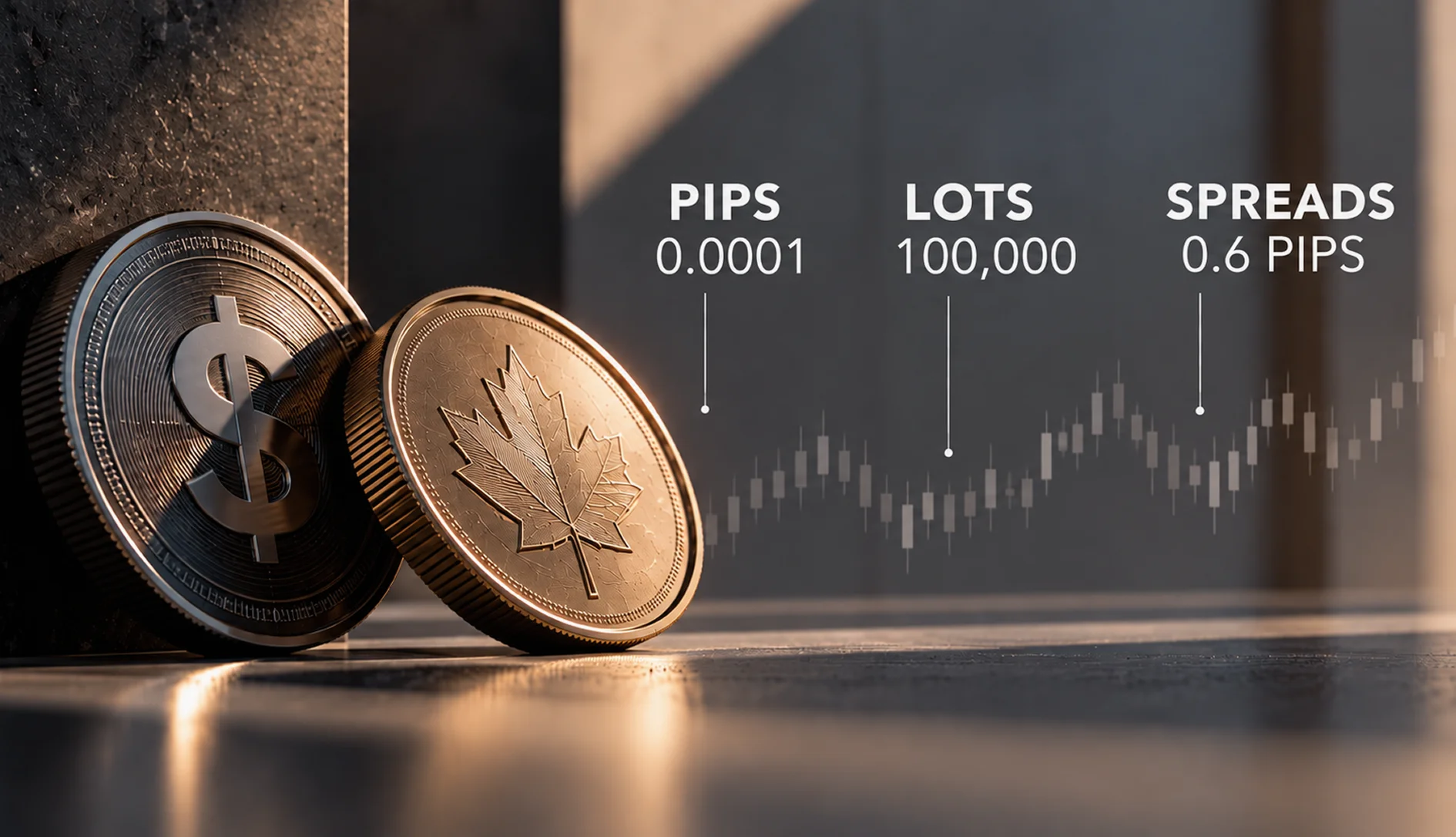
A pip is the standard unit for measuring a currency pair’s price change. For most pairs, including USD/CAD, one pip is 0.0001. A lot is the size of your trade, and the spread is the gap between the buy and sell price. Together, they determine what every pip of movement is worth to you.
If USD/CAD moves from 1.3700 to 1.3701, it has moved one pip. That’s the whole definition. What makes pips useful is that they let traders talk about price moves in a consistent unit, whatever the pair and whatever the trade size.
Most guides explain all this in U.S. dollars. This one uses USD/CAD and Canadian-dollar accounts throughout, because that’s how the math actually looks for many Canadian traders, and because USD/CAD has a neat quirk that makes the numbers easier.
What is a pip in forex?
A pip is the fourth decimal place in most currency quotes, or 0.0001. Pairs involving the Japanese yen are the main exception: there, a pip is the second decimal place, or 0.01. The term is commonly expanded as “percentage in point” or “price interest point.”
Currencies usually move in tiny increments, so traders needed a shared unit. Saying “USD/CAD rallied 45 pips” is clearer than “it rose 0.0045,” and it works the same way whether you’re talking about a small position or a large one. If you trade currency pairs online, pips are the language your platform, charts and trade history all speak.
Dealers have their own shorthand too. In a quote of 1.3718, the “1.37” is often called the big figure, and a trader might simply say the price is “18.” When the big figure changes, that’s a move of 100 pips.
What is a pipette?
A pipette, or fractional pip, is one-tenth of a pip: the fifth decimal place on most pairs, or 0.00001. Many platforms quote prices to five decimals, so the last digit you see is a pipette, not a pip.
This trips up a lot of newer traders. If USD/CAD moves from 1.37180 to 1.37230, that’s 50 pipettes, which is 5 pips, not 50. Always count from the fourth decimal.
What is a lot in forex?
A lot is a standard trade size, measured in units of the base currency, the first currency in the pair. A standard lot is 100,000 units, a mini lot is 10,000, and a micro lot is 1,000. On USD/CAD, one standard lot means 100,000 U.S. dollars of exposure.
Not every platform uses lots. Some let you enter any number of units, such as 25,000 or 3,500. The math doesn’t change, only the label. Whatever platform you use, check which convention your order ticket uses before placing a trade, because confusing 1 lot with 1,000 units is a hundredfold mistake. Minimum and maximum trade sizes also vary between providers.
| Lot type | Units of base currency (USD) | Value of one pip on USD/CAD |
| Standard lot | 100,000 | C$10.00 |
| Mini lot | 10,000 | C$1.00 |
| Micro lot | 1,000 | C$0.10 |
How do you calculate pip value?
Multiply the pip size by the number of units you’re trading. The answer comes out in the quote currency, the second currency in the pair. For USD/CAD, the quote currency is the Canadian dollar, so the result is already in C$.
That’s the quirk that makes USD/CAD friendly for Canadian accounts. One standard lot: 100,000 × 0.0001 = C$10 per pip. No conversion needed, and the pip value stays fixed no matter where USD/CAD is trading.
Other pairs need one extra step. On EUR/USD, the quote currency is the U.S. dollar, so one standard lot is worth US$10 per pip. To express that in Canadian dollars, multiply by the USD/CAD rate. Using a hypothetical rate of 1.3700, that’s about C$13.70 per pip. The Canadian-dollar value shifts as the exchange rate moves.
The same logic in reverse matters if your account is in U.S. dollars and you trade USD/CAD. The C$10 pip value is converted back at the current rate, so at a hypothetical 1.3700, one standard-lot pip is worth about US$7.30. The Bank of Canada publishes daily average exchange rates each business day, which are handy for checking conversions like these after the fact, though live trading uses real-time prices.
What is a spread, and why does it matter?
The spread is the difference between the bid, the price at which you can sell, and the ask, the price at which you can buy. It’s measured in pips and is often the main trading cost on a forex position. Every trade starts slightly underwater by the amount of the spread.
Suppose, hypothetically, USD/CAD is quoted at 1.37162 bid and 1.37180 ask. The difference is 0.00018, or 1.8 pips. On one standard lot, where each pip is worth C$10, crossing that spread costs C$18 the moment you open the trade.
Spreads aren’t fixed. They tend to be tighter when markets are busy and liquid, and wider when trading is thin, such as late at night or over holiday periods, or when big news hits. Central bank decisions are a prime example; our guide on how Bank of Canada decisions affect the CAD explains why the minutes around 9:45 a.m. ET announcements can be so volatile.
Some accounts also charge a commission on top of a narrower spread, and leveraged positions held overnight may carry financing charges. How these costs are structured varies by provider and account type, so compare the total cost of a trade rather than the spread alone.
| Term | What it measures | USD/CAD example (hypothetical) |
| Pip | Standard unit of price change (0.0001) | 1.3700 → 1.3701 is one pip |
| Pipette | One-tenth of a pip (0.00001) | 1.37180 → 1.37190 is one pip, or ten pipettes |
| Lot | Trade size in units of the base currency | 1 standard lot = US$100,000 of exposure |
| Spread | Gap between bid and ask, in pips | 1.37162 / 1.37180 = 1.8 pips |
How do pips, lots and spreads combine into profit or loss?
Profit or loss equals the number of pips the price moves in your favour or against you, multiplied by the pip value of your position. Because you buy at the ask and sell at the bid, the spread is already built into that result.
A hypothetical worked example: you buy half a standard lot (50,000 units) of USD/CAD at the ask of 1.37180. Pip value is 50,000 × 0.0001 = C$5. Later, the bid reaches 1.37680 and you close the trade. That’s 50 pips × C$5 = C$250, before any commission or financing.
Now flip it. If the bid had fallen 50 pips below your entry price instead and you closed there, the result would be a C$250 loss. The math is perfectly symmetrical; only your outcome isn’t.
How do traders use pip value to size a position?
They work backwards from the loss they are willing to accept. Decide how much you could lose on the trade, set where your exit would be, then choose a position size so that the distance to that exit, measured in pips, costs no more than that amount.
Here’s a hypothetical example. A trader with a C$10,000 account decides to risk no more than C$100 on one trade. Their planned stop is 40 pips from entry. C$100 ÷ 40 pips = C$2.50 per pip. On USD/CAD, each 10,000 units is worth C$1 per pip, so the position works out to 25,000 units, or 0.25 of a standard lot.
This is an illustration of the method, not a recommendation of any risk level. Also keep in mind that a stop order isn’t a guaranteed exit price: in a fast market, it can be filled at a worse level, so the actual loss can exceed the planned one.
Leverage doesn’t change pip value. It changes how much margin your account has to put up to hold the position. A 25,000-unit USD/CAD trade is worth C$2.50 per pip whatever leverage is applied; higher leverage just makes it easier to open a position far larger than your account can safely absorb.
What should you check before choosing where to trade?
Look at the full cost of trading the pairs you actually use, including spreads at the times you usually trade, commissions and overnight charges. Then look at how orders are filled in fast markets. Published figures are a starting point; other traders’ experiences fill in the gaps.
Typical spreads on a provider’s website can differ from what you see during news events or quiet hours. It’s worth reading independent reviews and user feedback alongside any provider’s own information, including what traders say about NumanCap, and checking whether complaints mention the same issues repeatedly.
Finally, practise the math until it’s automatic. If you can glance at a position and know what 10 pips is worth in Canadian dollars, you’ll make better decisions about size, and fewer expensive surprises. This guide is part of the forex basics series from NumanCap CFD trading.
Frequently asked questions
What is a pip in forex?
A pip is the standard unit of price movement in a currency pair. For most pairs, including USD/CAD and EUR/USD, one pip equals 0.0001, the fourth decimal place. For pairs involving the Japanese yen, one pip equals 0.01. Traders use pips to measure price changes, spreads, profits and losses consistently.
How much is one pip worth on USD/CAD?
On USD/CAD, one pip is worth C$10 for a standard lot of 100,000 units, C$1 for a mini lot and C$0.10 for a micro lot. Because the Canadian dollar is the quote currency, these values stay fixed in Canadian dollars regardless of the exchange rate, which simplifies the math for CAD accounts.
What is the difference between a pip and a pipette?
A pipette is one-tenth of a pip. On most pairs, a pip is the fourth decimal place (0.0001) and a pipette is the fifth (0.00001). Many platforms quote five decimals, so a move from 1.37180 to 1.37230 is 5 pips, not 50. Always count pips from the fourth decimal.
Why do forex spreads widen?
Spreads widen when fewer buyers and sellers are active or when uncertainty spikes. That often happens during quiet overnight hours, holidays and major news such as central bank decisions or employment reports. Wider spreads raise the cost of opening and closing trades, so many traders check spreads before entering around scheduled events.
How many units are in a standard, mini and micro lot?
A standard lot is 100,000 units of the base currency, a mini lot is 10,000 units and a micro lot is 1,000 units. On USD/CAD, the base currency is the U.S. dollar. Some platforms let you trade any number of units instead of lots, so always check your order ticket.
This article is for general educational purposes only and is not financial, investment, tax or legal advice. All prices, account sizes and trade examples are hypothetical illustrations, not forecasts or recommendations. Trading leveraged products such as CFDs and forex carries a high risk of losing money quickly, and you can lose more than you expect. Trading costs, lot conventions and order handling vary by provider. Whether these products are available to you, and the rules that apply, vary by country and province; confirm what applies where you live before trading.